

MXA RACE TEST: 2026 YAMAHA YZ450F
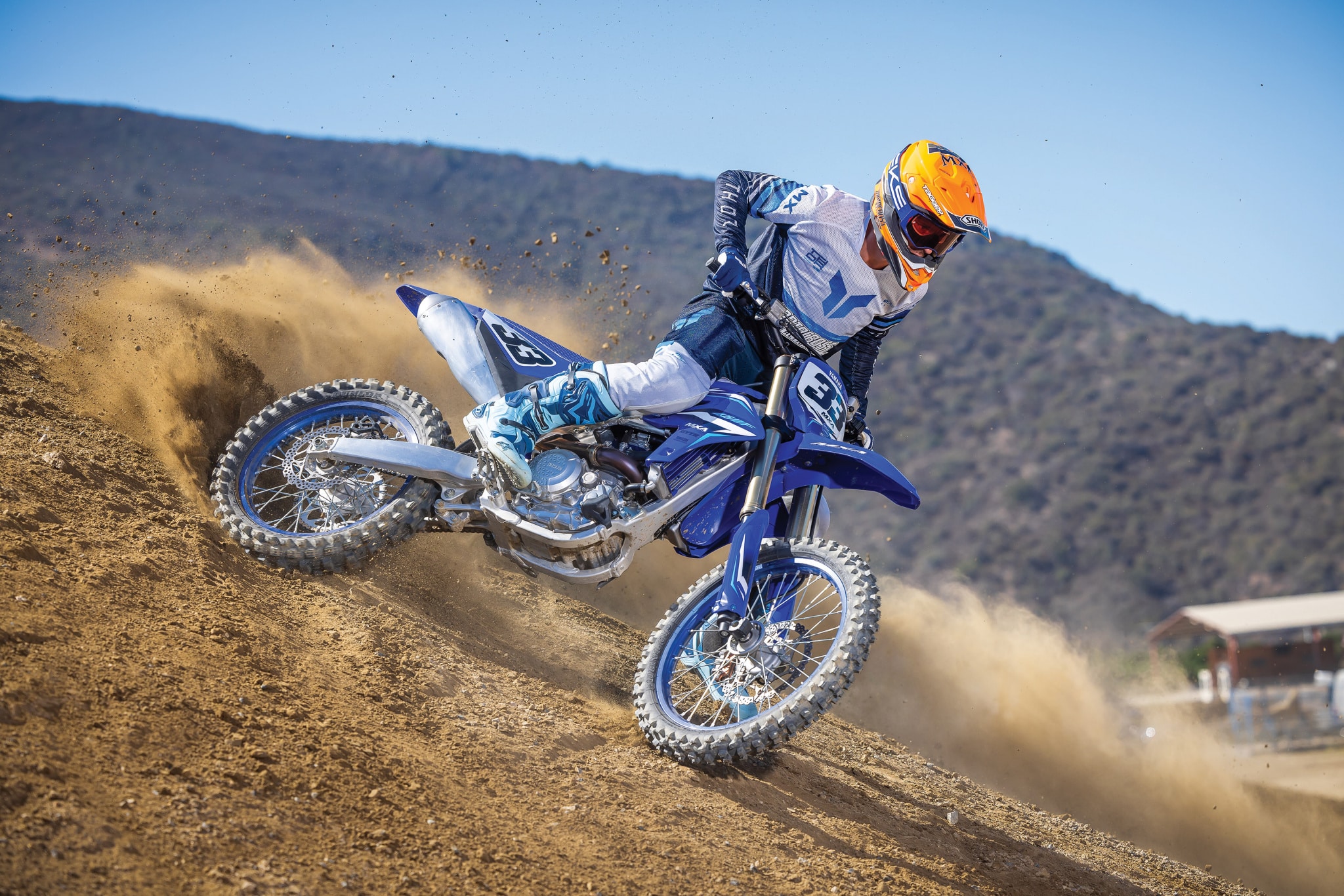 THE GEAR: Jersey: ThorMX Launchmode Air, Pants: ThorMX Launchmode Air, Helmet: Shoei VFX-Evo, Goggles: EKS Brand Lucid, Boots: Alpinestars Tech 10.
Q: FIRST AND FOREMOST, IS THE 2026 YAMAHA YZ450F BETTER THAN THE 2025 YAMAHA YZ450F?
A: Indeed, it is! The previous model was a bit of a paradox. Its most impressive feature, its powerhouse engine, was also its biggest drawback. The bike had so much raw power that it often overwhelmed the chassis, making it feel twitchy and unstable at speed. Looking back, Yamaha came out with an all-new bike in 2023, and it was good enough to win MXA’s “450 Shootout” two years in a row. Last year, Yamaha focused their updates on the suspension, but the changes didn’t deliver a dramatic improvement. While the new settings helped reduce front-to-rear pitching, they created more side-to-side movement. The front end still tended to shake its head, especially when riding aggressively.
Our test riders found they had to ride the 2025 model with patience. It was incredibly fast, and it rewarded smooth, calculated riding over all-out aggression. Ironically, our highest praise for the 2025 YZ450F also doubled as our biggest criticism. The engine was outstanding, but unless you were in top race shape, it was exhausting to ride. Our vet and novice testers liked riding it casually, but preferred not to race it. On the other hand, our pro riders loved pushing it to its limits.
For 2026, Yamaha has completely revamped their YZ450F in an effort to answer our requests for a smoother, more rideable bike that would work for a larger window of riders while also reducing sound and improving durability in a few key areas.
Q: HOW HAS THE AMA RULEBOOK CHANGED YAMAHA’S YZ450F?
A: During sound testing, the stock 2025 YZ450F hit 116 decibels, which won’t even pass the current 2025 AMA rule for Pro-class racing at 114 decibels. Now, our 2026 YZ450F test bike landed between 108 and 109 decibels during our three sound test runs with the official AMA sound meter.
The bigwigs at Feld Entertainment, MX Sports, the AMA, and the FIM believe that lowering the sound requirements for motocross and Supercross would help our sport as a whole. Their goal was to get the OEMs to make quieter bikes so that public tracks will have fewer noise complaints from neighbors, and won’t be shut down as easily. Unfortunately, they don’t realize that quieter bikes are slower bikes, and aftermarket companies will quickly find a way to make the bikes faster and louder for consumers who don’t want to ride choked-up motorcycles, defeating the purpose in the end.
In the case of the Kawasaki KX250/KX450 models, meeting the quieter sound requirements has impaired their engines greatly. However, even though the sound requirements are completely unnecessary for Pro-class racing, in the case of the Yamaha YZ450F, we are thankful this bike has been made quieter. Its ultra-loud, forward-positioned air intake and loud exhaust note have been points of contention for our test riders over the years, and everyone is glad it’s quieter.
Q: WHAT’S NEW ABOUT THE 2026 YAMAHA YZ450F ENGINE?
A: Yamaha made an extensive list of changes to the engine on the 2026 YZ450F. The first five points affect engine character, making it quieter and smoother. The next five points address the engine’s durability.
(1) Intake. The air intake is still at the front of the seat, and from the outside, it looks identical to the previous intake, but inside, it’s been updated with a new resonator and a duct being added into the air boot to reduce the blaringly loud intake noise.
(2) Cylinder head. The intake port shape has been changed from round to oval, and the intake port walls have been made steeper. Additionally, the throttle-body shape has been updated to match the intakes and improve combustion efficiency. The intake camshaft timing has also been changed from 110 to 107 degrees to help increase low-end torque.
(3) Flywheel. The flywheel has been made heavier with an 8-percent increase to the moment of inertia to smooth out the abrupt low-end engine character.
(4) Clutch. Yamaha has officially joined the hydro-clutch gang. A Nissin hydraulic clutch has replaced the YZ450F’s cable clutch, which means you don’t have to adjust the clutch on the fly as it heats up and cools down, and the bike now has a softer pull at the lever. Plus, thanks to the softer hydro pull, Yamaha was able to make their Belleville clutch spring stiffer with 10 percent more set load and a stronger engagement. The clutch also has more holes in the pressure plate for weight reduction and improved cooling. Plus, the clutch’s push-rod gets a new bushing added to the main transmission shaft for durability.
(5) Gearing. To pick up some of the low-end grunt that was lost during Yamaha’s noise-reduction efforts, the gearing has been switched from 13/49 to 13/51. This shortens the gear ratios.
(6) Connecting rod. The connecting rod has been known to break and cause catastrophic failures on previous YZ450F models. The 2026 connecting rod has a new material for the con-rod bearing.
(7) Water outlet. The plastic water outlet, connecting the cylinder head to the radiator hose, has been replaced with an aluminum joint. We never had issues with ours, but riders who’ve used Evans waterless coolant would melt the black plastic piece. XPR Motorsports makes a fancy CNC-machined replacement for the 2025 and earlier models.
(8) Breather hose. Previously, the stock YZ450F engine breather hose was routed into the airbox. This is normal for dual-sport bikes with strict emission standards, but not necessary on competition-ready dirt bikes. If you saw a Yamaha tip over and land on its side or upside down, and then puff white smoke out of the exhaust, you also saw oil come out of the engine’s breather hose and into the intake to be burned off in the combustion chamber. Twisted Development makes a bypass for this, but now Yamaha has re-routed the breather hose on the 2026 YZ450F. It exits through the hose at the front left of the frame.
(9) Oil sprayer. The piston-oil sprayer angle has been changed for improved piston cooling.
(10) Exhaust. To make the bike quieter, a small resonator has been added to the mid-pipe, and the muffler’s internals have been altered so that it has a larger perf core (going from 45mm to 48.6mm), a new cone baffle, and a shorter tail pipe with an additional perforated section and a closed off end pipe. Basically, the muffler is choked up to become quieter. The muffler is also about 2 inches shorter, and it’s been angled down 1.6 degrees, which is nicer for grabbing the rear fender to lift the bike onto the stand.
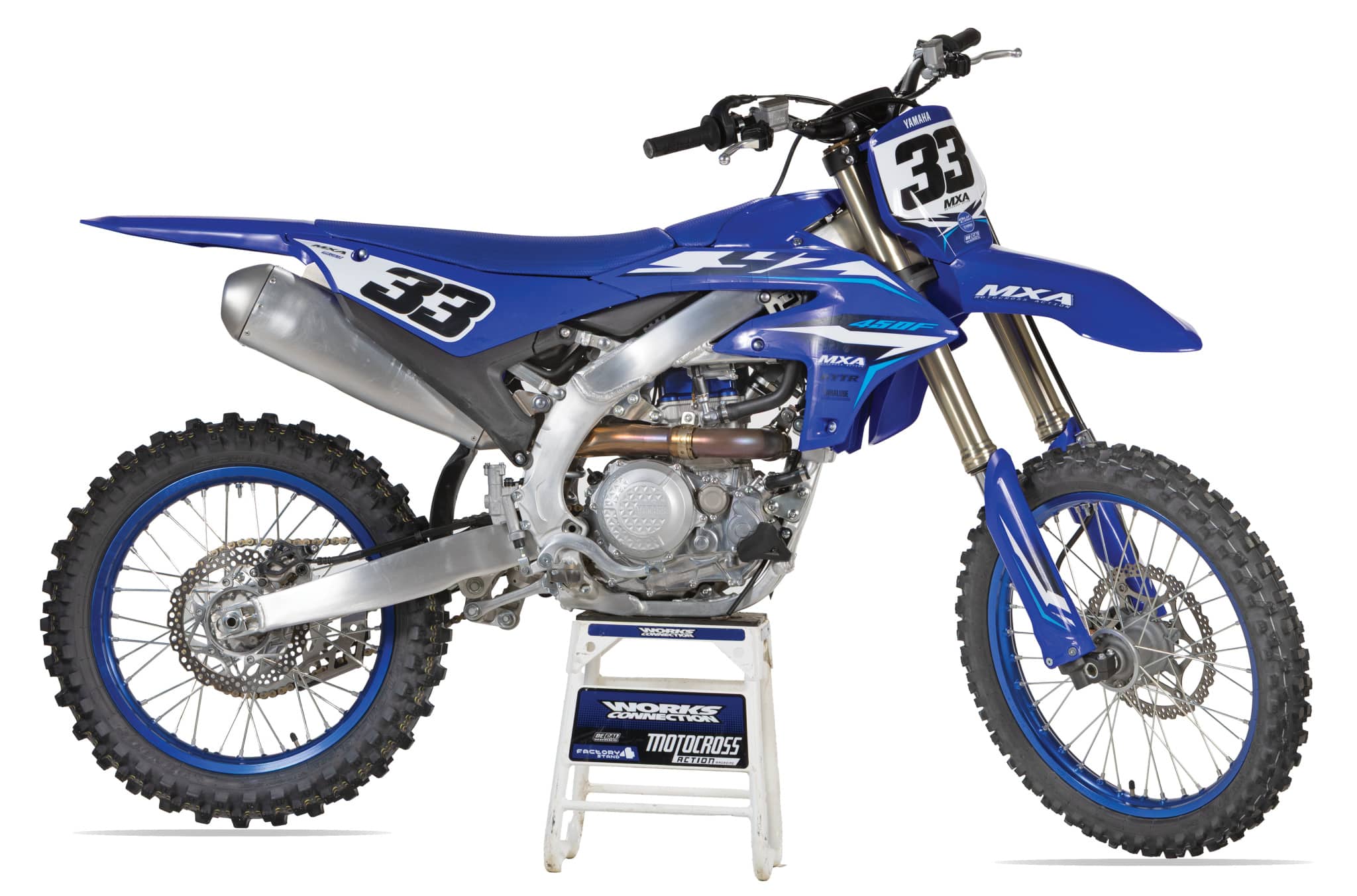 Yamaha’s biggest problem is that they didn’t change the plastics or graphics enough for 2026. Under the hood, this bike has a long list of meaningful updates, but on the exterior, it’s hard to notice the effort Yamaha made.
Q: WHAT’S NEW ABOUT THE 2026 YAMAHA YZ450F CHASSIS?
A: Here are the rest of Yamaha’s updates to the new YZ450F.
(1) Frame. Yamaha wanted to optimize the rigidity of the frame by forging a new downtube with the cradle section being made 5mm thinner for more absorption, and the head tube area was made 5mm thicker for increased rigidity.
(2) Engine mounts. In conjunction with the thinner frame cradle, the front engine-mount brackets have a slightly different shape, and they’ve gotten thinner. The YZ450F used to have 8mm mounts on both sides, but for 2026, the right side mount is 4mm thick and the left side is 6mm.
(3) Shock mount. The rear shock mount previously had a hole in the bracket, but that has been filled in for 2026 to make it stiffer.
(4) Shock. The rear shock is brand new with a new base valve that has a larger piston (from 24mm to 28mm) with its own dedicated compression and rebound passages. The main-valve piston ports have been increased from 4 to 6mm to reduce stress in the shim stack. The shock also has a tool-less low-speed compression adjuster for quick changes on the track (a 17mm socket fits over the top of it for adjusting the high speed). Yamaha claims the new base valve is similar to what comes on the Kayaba A-kit shock.
(5) Fork. The Kayaba SSS fork settings have been updated to work with the shock, and a new scraper was added between the dust and oil seal to extend the fork seal’s lifespan.
(6) Bodywork. The 2026 YZ450F is dressed in updated plastics. The side number panels have been altered for an improved contact patch (and to prevent you from snagging your boots on the edges), the front number plate shape was changed to mimic the Stark Varg, and the seat cover is slightly more grippy.
(7) Miscellaneous. Yamaha switched the cable holders at the steering head from steel to plastic, the chain roller is much smaller, and the rear brake-hose clamps are much cleaner and lighter. The map-switch connector has an extra layer of protection against moisture. The radiator louvers were also changed from black to blue, and the Yamaha Power Tuner app has gained a new ECU lock feature for theft prevention.
Q: HOW DOES THE 2026 YAMAHA YZ450F ENGINE WORK ON THE TRACK?
A: For the last few years, we’ve raved about Yamaha’s YZ450F engine being the only “true 450” in the class. While their competitors tailored their engines for a smooth, broad and linear style of power, Yamaha’s explosive power was the most intimidating 450cc engine of the bunch. However, because it was so fast, it scared many of the average Joes who bought it (and even AMA pros remapped it to be more manageable).
Thankfully, the 2026 YZ450F engine has addressed MXA’s requests for more usable power! MXA’s test riders were quick to confirm that the 2026 YZ450F was quieter, smoother and easier to ride. Every Yamaha YZ450F owner (besides Eli Tomac) took steps to detune the 2025 YZ450F in hopes of creating a smoother power character. Even the aftermarket exhaust companies tailored their exhausts to smooth out the herky-jerky low end of the 2023–2025 engine. From the get-go, the stock 2026 YZ450F is plenty smooth.

Thanks to Yamaha, our test riders had the opportunity to compare a fresh stock 2025 YZ450F against the new 2026 YZ450F, and the contrast was evident. Both bikes are fast, but test riders were able to ride faster, longer, and in more control on the 2026 because of the more predictable throttle response and manageable power.
Going from a 49-tooth sprocket to a 51-tooth sprocket is a massive jump, and it exposes just how much power the 2026 YZ450F lost. Our testers spent the first few days riding with the 51-tooth sprocket on the rear, and they felt the YZ450F was in the ballpark of last year’s bike. However, once we threw a 49-tooth sprocket on the 2026 model, it became evident how much horsepower this engine gave up. The 49-tooth sprocket was not feasible for motocross, requiring too much clutch work in the corners. We tried a 50-tooth sprocket that our vet test riders preferred because it lengthened second gear, allowing riders to hit corners in second gear without having to shift as quickly. Our faster test riders stuck with the stock 51-tooth sprocket because it more closely mimicked the low-end grunt of the 2025 model, with the caveat that it requires a much quicker left foot.
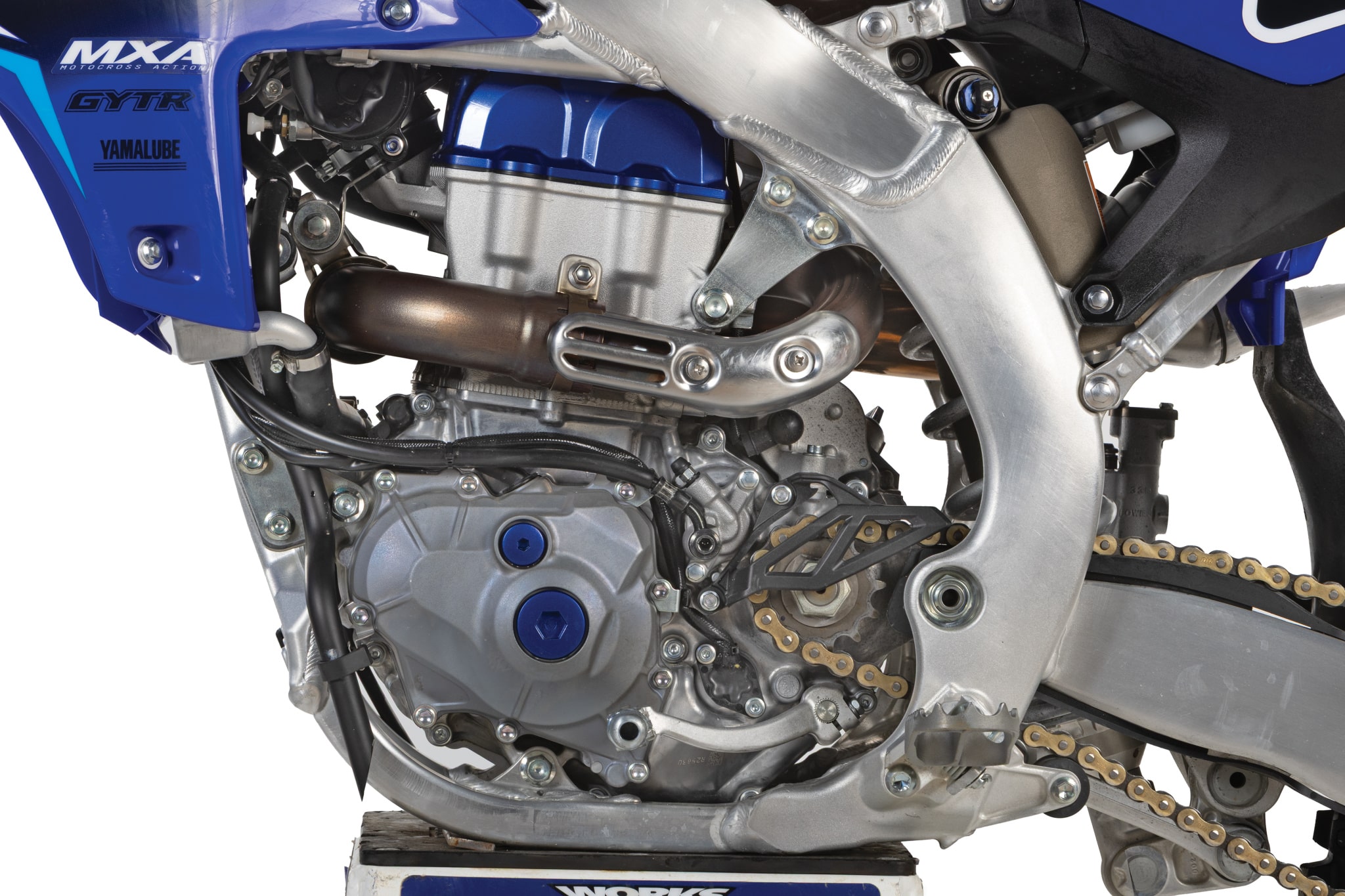 The YZ450F dropped from 59.5 to 56.7 horsepower, but we aren’t complaining about it.
Q: HOW DOES THE 2026 YAMAHA YZ450F ENGINE WORK ON THE DYNO?
A: If we hadn’t done our due diligence of testing the 49-tooth rear sprocket or putting this bike on the dyno, our test riders would never have guessed that this bike was three horsepower shy of last year’s 59.5 peak horsepower number. However, the dyno is our canary in the coal mine, and it says that this engine is a much mellower version of the Yamaha YZ450F.
Cracking the throttle open at 5500 rpm, the 2026 makes 29 horsepower, while the 2025 made 33 horsepower. At 6500 rpm, the 2025 is only half a horsepower stronger. At 8000, the 2025 is 1-1/2 horsepower stronger than the 2026 YZ450F, and at 9000, the 2025 is two horsepower stronger. Our 2025 Yamaha YZ450F test bike peaked with 59.5 horsepower at 9700 rpm and 36.2 pound-feet of torque at 7300 rpm, while the 2026 engine, which was 7 decibels quieter, hit 56.7 horsepower at 9600 rpm and 35.1 pound-feet of torque at 7500 rpm.
The dyno numbers surprised us because Yamaha gave up almost three horsepower, but the bike still feels exceptionally strong in motion. For anyone who wants to get back some of the lost power, Yamaha’s GYTR catalog is selling the 2025 airbox (with the breather-hose port blocked off). However, when we tested the 2026 bike with the 2025 air box and the stock 2025 exhaust, our test riders preferred the 2026 setup.
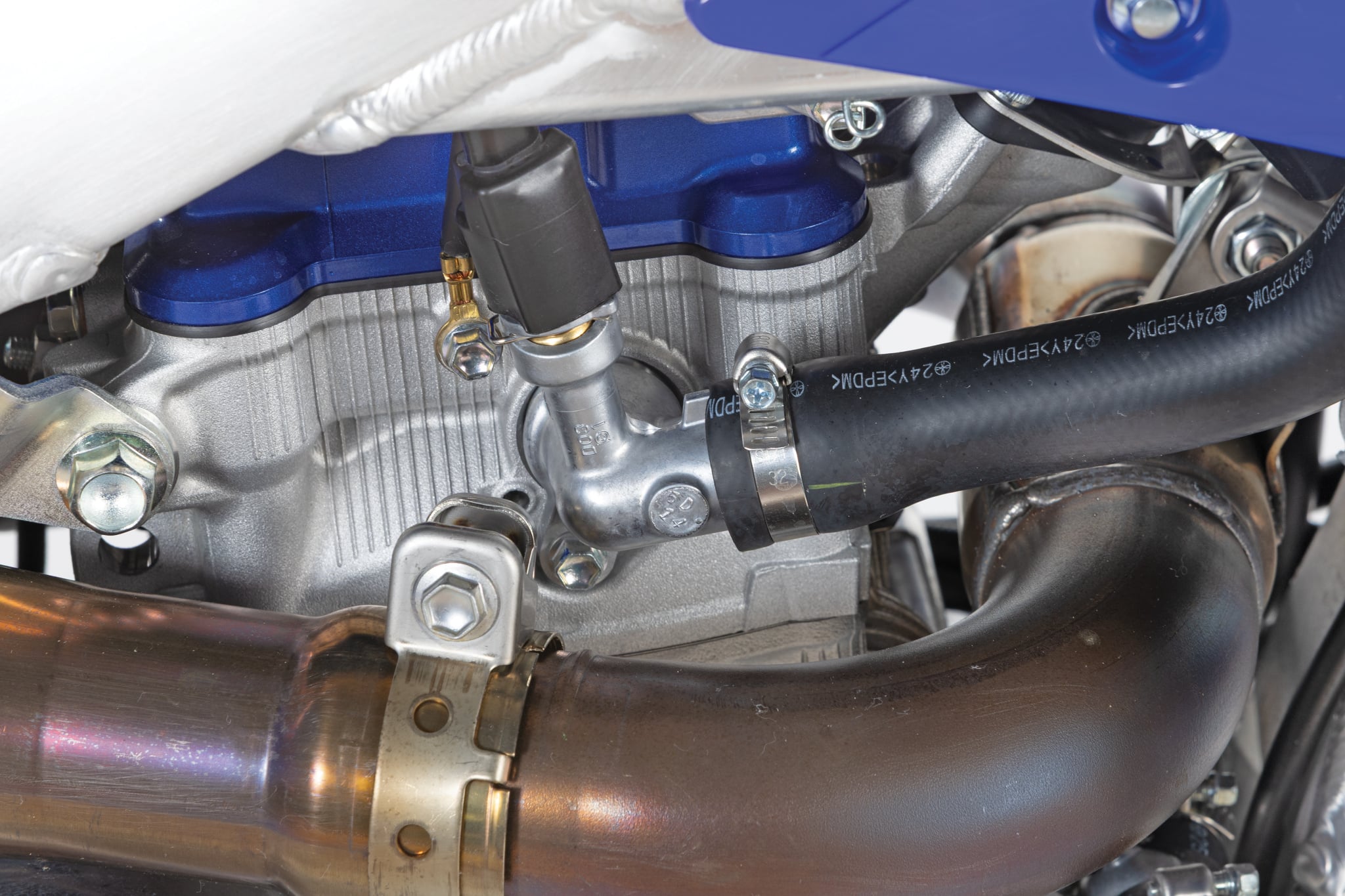 This water outlet was changed from plastic to aluminum in 2026.
Q: HOW DOES THE 2026 YAMAHA YZ450F HANDLE ON THE TRACK?
A: One of our favorite aspects about the recent iterations of the YZ450F, starting in 2023, was that the rear wheel hooked up like a cat on carpet. However, the abrupt throttle-to-rear wheel connection was also a point of consternation, because it overpowered the chassis and caused errant wheelies and mistakes in ruts. Yamaha’s goal for the 2026 frame was to go stiffer at the steering stem to create a precise front-end feel, while the softer frame cradle was aimed towards creating a more compliant feel in the harsh chop, making the bike feel more planted to the ground.
On the handling side of things, MXA testers griped about the 2023–’25 YZ450F being unstable and twitchy. The new bike is an improvement on the stability and chassis balance side of things, but it’s still not anything like the 2022 YZ450F. That bike was fat, fast and stable. It didn’t like to turn, but it was great at going in a straight line. Long-time Yamaha riders have quizzed the MXA test riders, inquiring about whether this new bike was as stable as the 2022 model, and our answer is a clear no. This chassis offers an improvement from last year, but it’s not 2022-esque, and we’re okay with that.
While it’s true that the new Yamaha is replete with chassis updates, we believe the main handling benefits came from the smoother engine. The hydraulic clutch alone is responsible for creating a smoother power character (this was also noticeable with the previous GYTR hydraulic clutch kit). During our initial test sessions we stuck pro, intermediate, novice, and vet riders on this bike, and everyone agreed that the chassis still felt light and playful, and it still was precise in the turns.
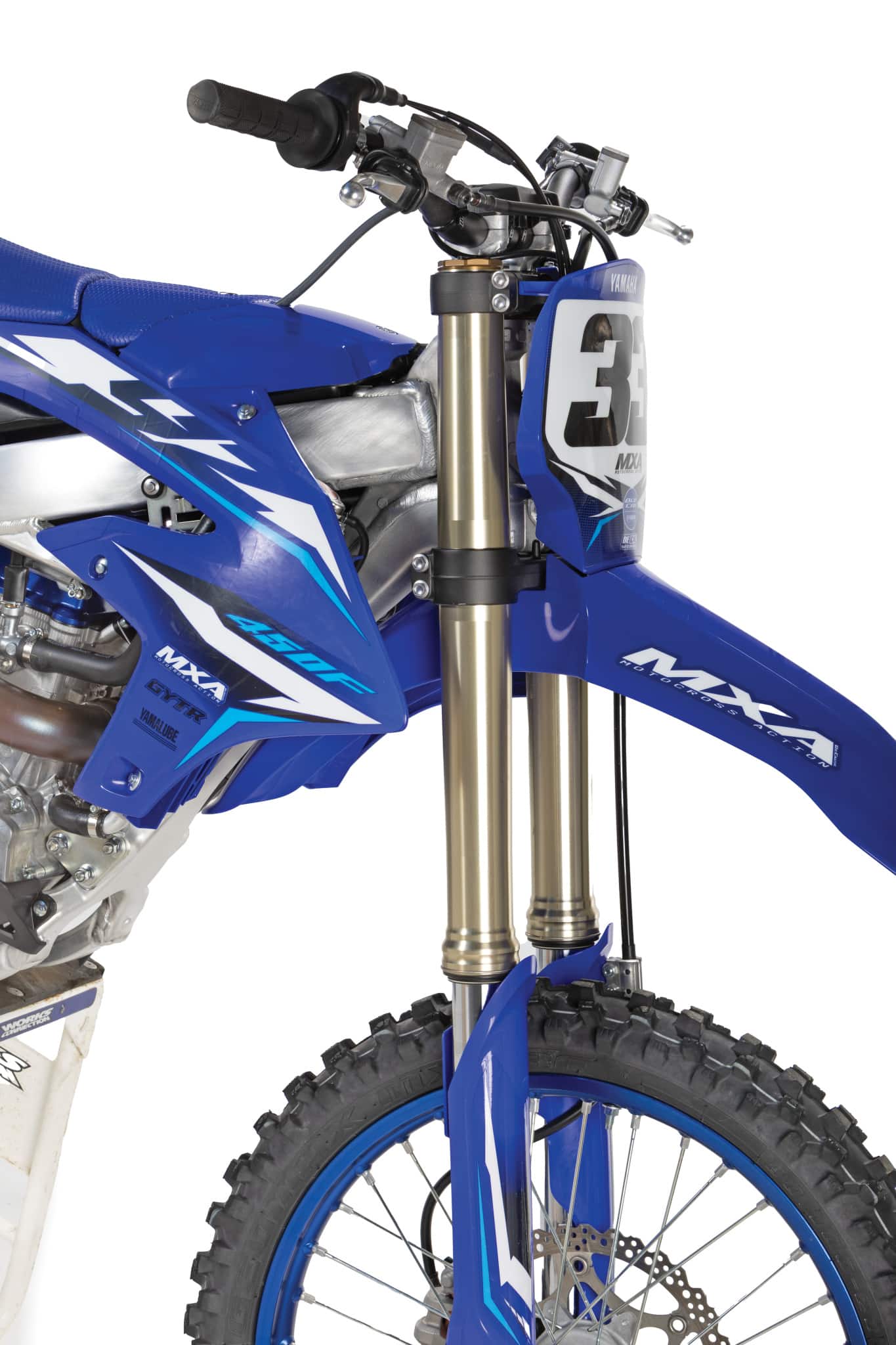 The KYB forks are on the soft side, which can make riders feel stiff because they ride lower in the stroke.
Q: HOW IS THE KAYABA SSS SUSPENSION?
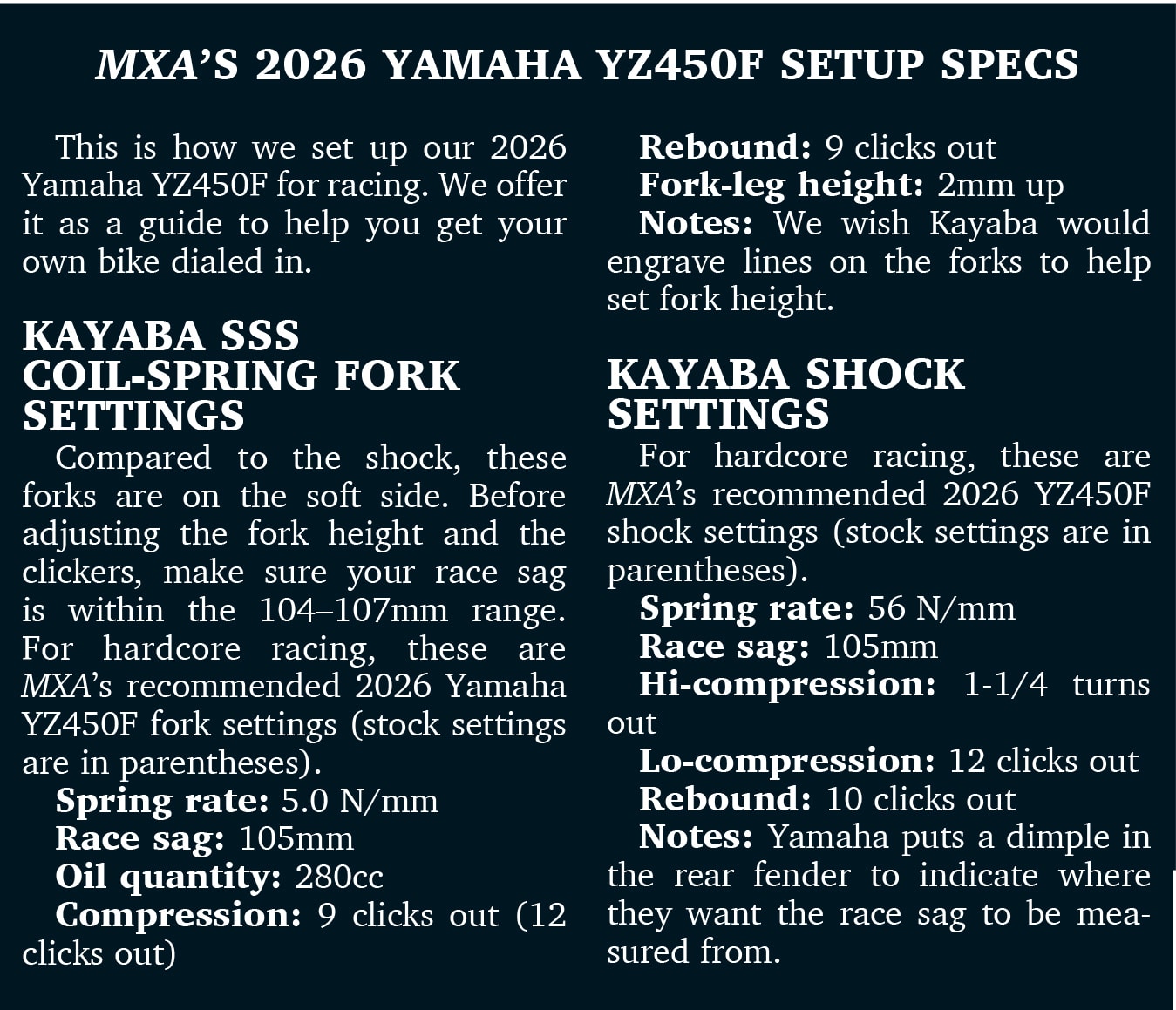
A: Yamaha has a reputation for having the best suspension, and while this year isn’t perfect, it’s not far off. Multiple test riders complained about a harsh feeling in the forks and originally, they thought they were too stiff. However, the forks are actually too soft, which meant that the forks were riding lower in the stroke where the damping was configured to ramp up and be stiffer, thus the harsh feeling. When we lowered the shock sag to the 106–107mm range, it took some weight off the forks. Then, we went two clicks stiffer on compression, and that helped hold the forks higher in their stroke, where the SSS forks are nice and plush.
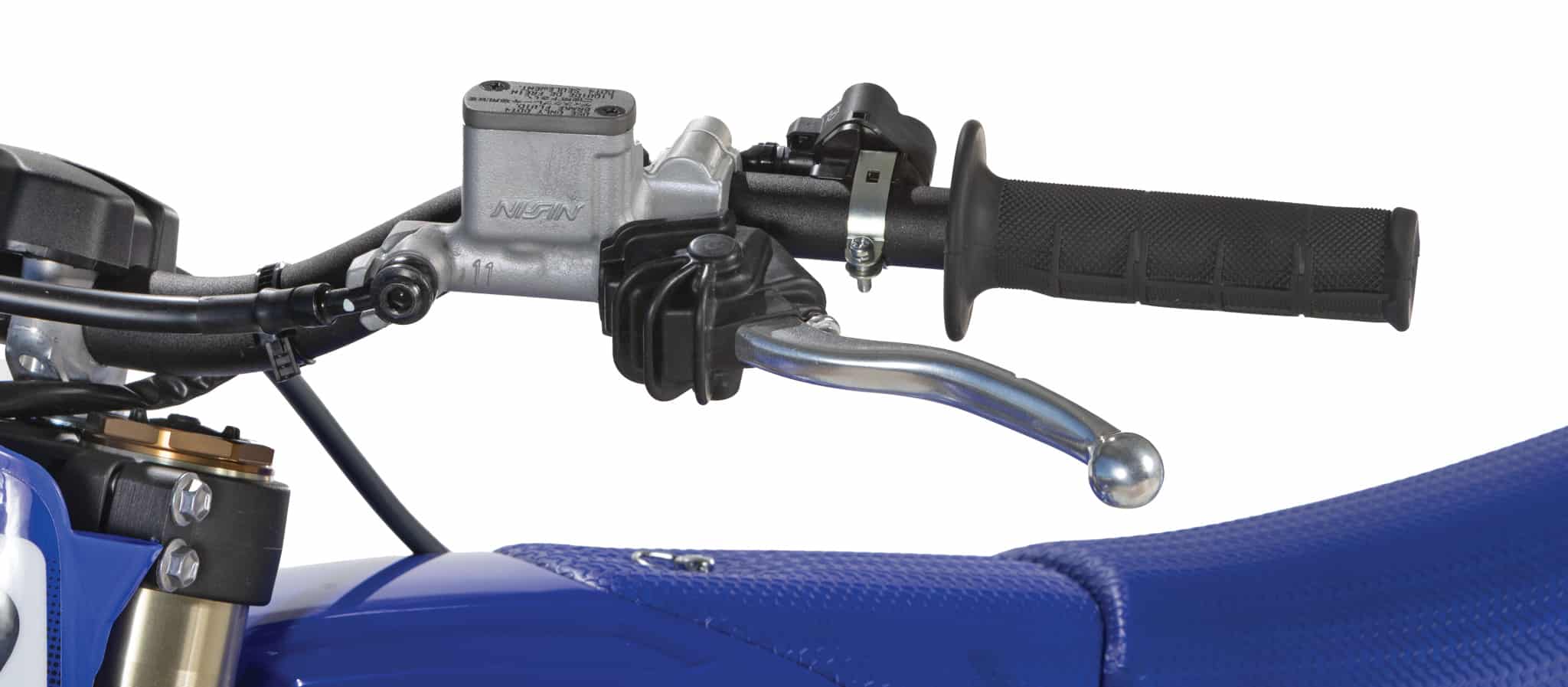 The new Nissin hydro clutch.
Q: WHAT DID WE HATE?
A: The hate list.
(1) Fuel cap cover. Yamaha has had a flap over the fuel cap ever since they turned their YZ450F engine backward and moved the airbox to in front of the seat in 2010. The Dzus fastener is convenient when it works, but we’ve lost multiple washers off our Dzus fasteners, which causes the flap to fall off, and then the airbox cover is the next to go. Once you start having issues with this, replace the Dzus fastener with an 8mm bolt and replace the Dzus-fastener receiver with a threaded clip-on to capture the bolt.
(2) Stator wires. It’s nice that Yamaha has cleaned up their wire management in a few areas on the YZ450F, but the stator wire and hydraulic clutch line are still exposed to the elements. Last year, our test bike died when the stator wire was severed mid-moto by a flying rock.
(3) Airbox. For the 16th year in a row we still don’t like the airbox. It’s too easy for dirt to fall into the intake when changing a filter. We keep a shop vac on standby to clean out the intake before installing a clean filter.
(4) Footpeg mounts. Most of our test riders don’t notice it, but some riders are still standing on the footpeg mounts rather than the pegs.
(5) Plastics. The new side number panels are an improvement over last year’s, but they aren’t perfect. One tester caught the top of his boot on the bottom of the subframe, causing him to tip over in a corner. It still needs a better contact patch.
(6) Radiator cap. For some reason, the Japanese brands continue to spec 1.1 kg/mm2 radiator caps (equal to 14.22 psi). We recommend getting a 1.8 kg/mm2 radiator cap (equal to 25.6 psi). The higher the pressure, the longer the water in your radiator will resist boiling.
(7) Clutch cover. The stock clutch cover is cast and unpainted, and it looks hammered after the first ride.
(8) Seat. The new gripper cover is better than before, but the round shape is not friendly to your behind.
(9) Exhaust. The backwards-facing engine and wrap-around exhaust make this bike the worst in class for removing and installing the exhaust system.
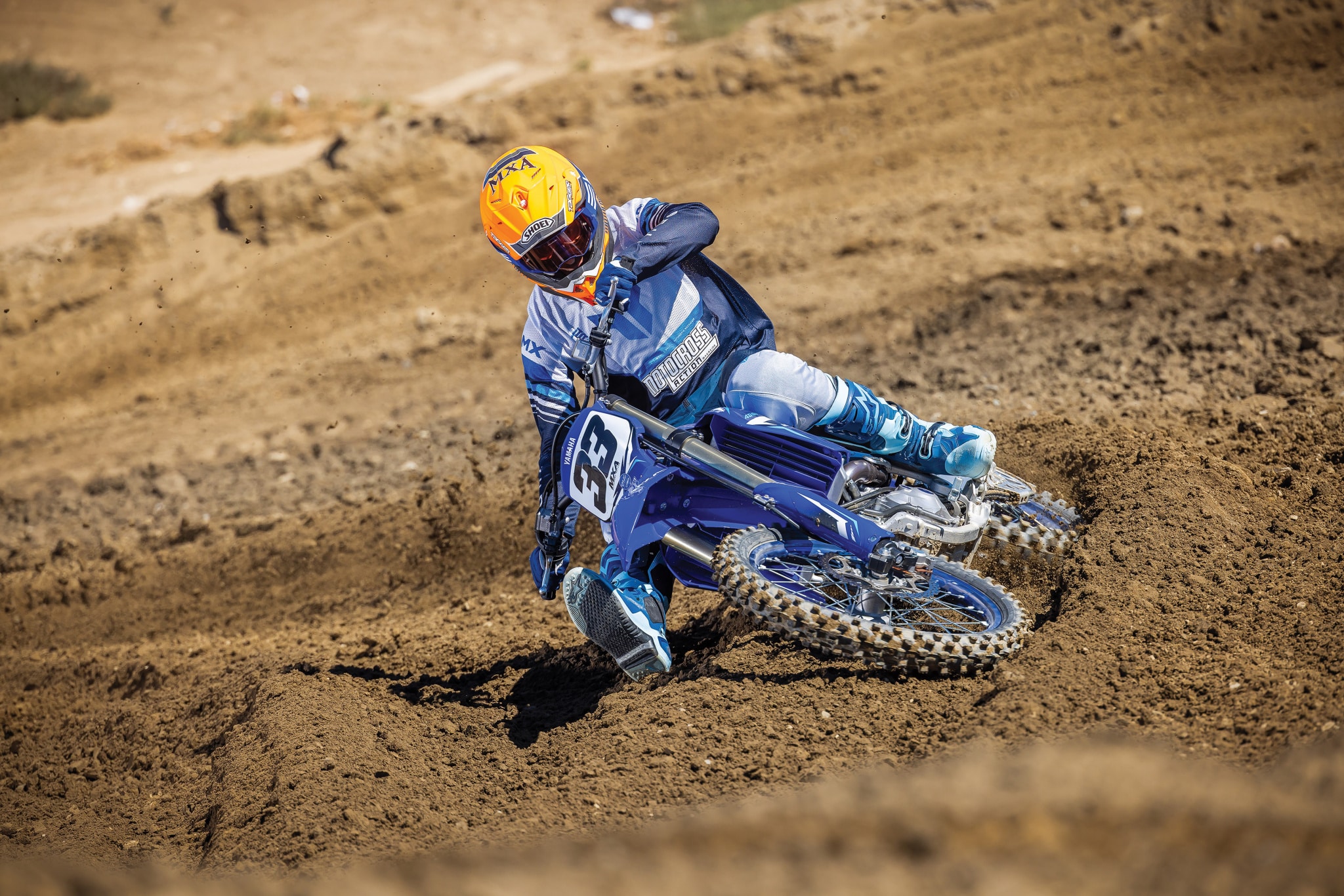 Compared to the 2023–2025 YZ450F models, the new YZ450F is now manageable for a much wider range of riders.
Q: WHAT DID WE LIKE?
A: The like list.
(1) Hydraulic clutch. It’s easier to pull. Plus, unlike a cable, it doesn’t require any mid-race adjustments. When Yamaha borrowed KTM’s Belleville-washer clutch design, we complained that their chosen clutch spring was too weak. Finally, the 2026 YZ450F gets the stiffer clutch spring that we felt would improve engagement and durability. And, it does!
(2) Sound. Yamaha 450s have been loud for years. MXA test riders always wear earplugs when they race the YZ250F and YZ450F. Our eardrums are thankful for the 109-decibel 2026 model.
(3) Power Tuner. The Yamaha Power Tuner app is easy to use, and it’s a nice place to track your maintenance intervals.
(4) Map switch. We’re thankful Yamaha added some extra plastic around the map-switch connector to protect against the ever-so-evil pressure washer.
(5) Shock removal. Removing the shock is much easier than removing the exhaust. Just take the seat and fuel tank off, and it comes out the top.
Q: WHAT DO WE REALLY THINK?
A: The new Yamaha YZ450F is everything we asked for and more. It’s quieter, smoother and offers more chassis comfort than the previous models. This setup has been refined to accommodate a broader range of riders, and even though it’s slower and more manageable for the average rider, the engine is still strong enough to make the YZ450F feel light and playful.


Comments are closed.